CO Art. 321c
Overtime (Überstunden)
Work beyond the hours agreed in the contract but below the statutory maximum. It is compensated with time off of equal length or paid with a 25 % supplement, unless otherwise agreed in writing.
Time tracking
Time tracking in Switzerland with teim: your team records working hours with a timer or adds them afterwards, right in the browser. teim calculates target hours, actual hours, overtime and cantonal public holidays automatically – as Art. 73 ArGV 1 requires.
Free until 31 January 2027 · then CHF 5.00 per company + CHF 3.00 per person per month · hosted in Switzerland
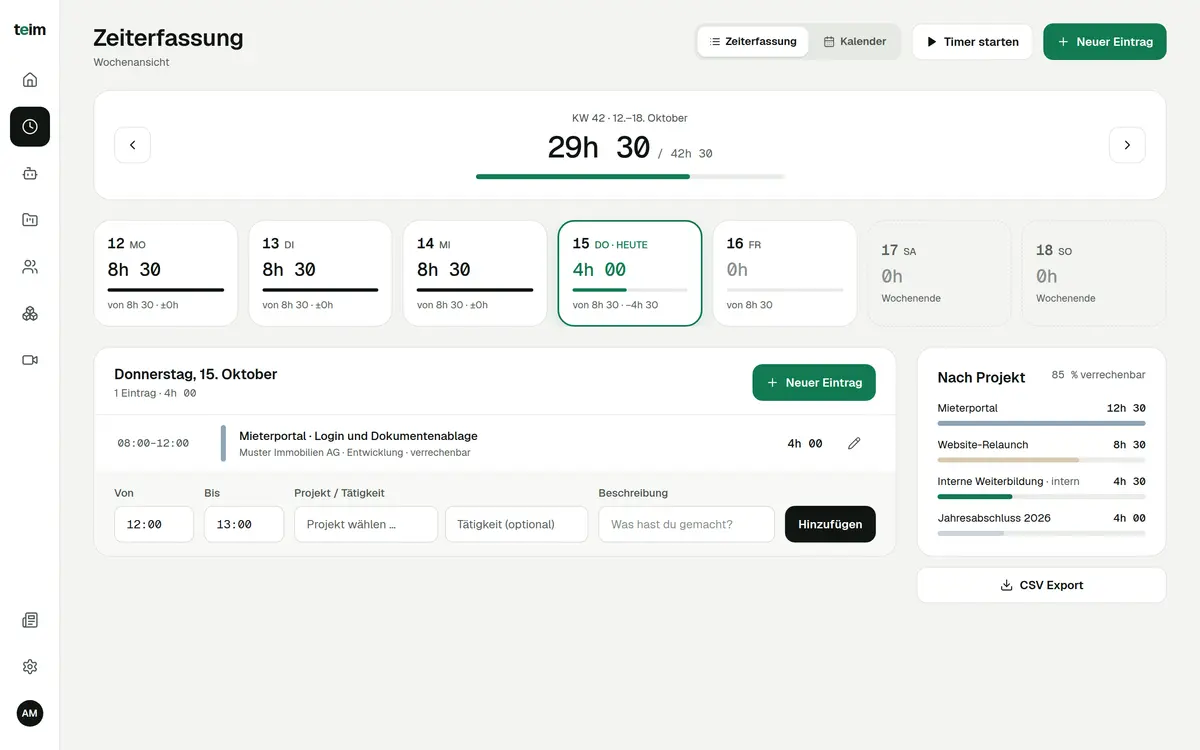
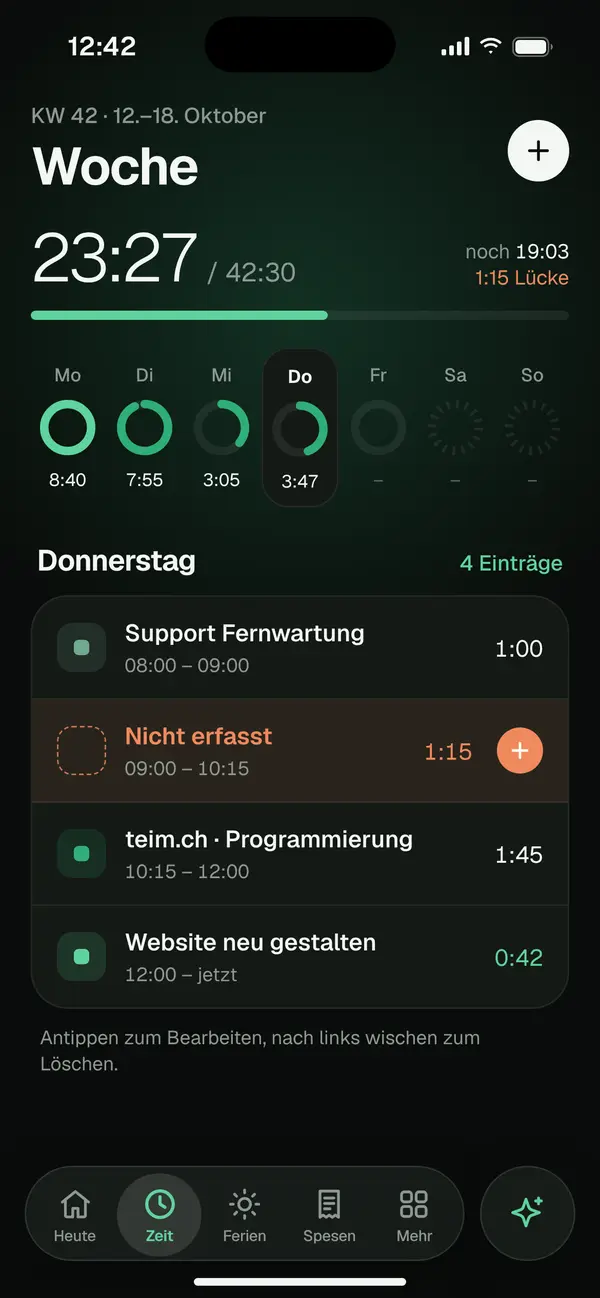
teim is Swiss software for time tracking, project management, expenses and absences for SMEs with 5 to 200 employees.
Last updated: 15 October 2026
How it works
Start the timer or add time afterwards – on a computer or in your phone’s browser. The timer keeps running across devices.
Every entry belongs to a project and an activity. You can set a default activity for each project.
teim calculates target, actual, overtime and billable hours. Managers see their team, accounting exports the data.
Legal basics
Under Art. 46 of the Swiss Labour Act (ArG) and Art. 73 ArGV 1, employers must keep records of working time. teim records the start, end and duration of work per day and week and does not delete entries automatically.
Sources: Swiss Labour Act (ArG) Art. 9, 12, 13, 46; ArGV 1 Art. 73–73b; Swiss Code of Obligations (CO) Art. 321c (fedlex.admin.ch). Not legal advice.
including compensatory time and excess hours, and when they were worked
timing and duration
unless they regularly fall on a Sunday
for excess hours, night work and Sunday work
at least five years after the records cease to apply
CO Art. 321c
Work beyond the hours agreed in the contract but below the statutory maximum. It is compensated with time off of equal length or paid with a 25 % supplement, unless otherwise agreed in writing.
ArG Art. 9, 12, 13
Work beyond the statutory maximum of 45 hours (offices, industry, retail in large companies) or 50 hours (all other businesses) per week. At most 2 hours per day and 170 or 140 hours per year. Compensated with time off or, as a rule, a 25 % wage supplement.
Features
Start, stop and switch in one click.
Target and actual per day, gaps at a glance.
See entries as a calendar instead of a list.
Every entry with a project and an activity.
Cantonal holidays, leave and absences taken into account.
Internal and billable hours kept apart.
Billable hours to bexio, the week as CSV.
Employees, managers, HR, admin.
FAQ
As a rule, full recording under Art. 73 ArGV 1: working time per day and week, excess hours, breaks of 30 minutes or more and rest days. Under certain conditions, simplified recording (Art. 73b) or waiving recording (Art. 73a) is allowed.
Recording the daily working time is enough. It is possible for employees who set at least 25 % of their working hours themselves. In companies with fewer than 50 employees, a written individual agreement is sufficient.
teim compares the hours recorded with the target, based on the company’s daily hours and each person’s employment level. teim shows the difference per week and as a running balance.
Yes. teim runs in the browser on any phone. The app for iPhone and Android is coming soon.
Time tracking is included in the price of CHF 5.00 per company and CHF 3.00 per user per month, together with all other modules. See pricing
teim does not delete time entries automatically. The law requires records to be kept for at least five years.
Free for everyone until 31 January 2027. No credit card required.